Translate

Sunday, 26 February 2017

Grade 2 Procedural Writing

procedure is an established way of doing something. Whenever you read how-to guides or follow step-by-step instructions, you're using procedural writing. Using procedural writing helps you accomplish a goal; it gives instructions for completing both common and complex goals.


Some topics that lend themselves to procedural writing include:
  • Directions: driving directions to the airport
  • Recipes: how to bake chocolate chip cookies
  • Technology Manuals: how to use your cell phone
  • Science Projects: how to make a paperclip float

Ms. Sen's Grade 2 and Ms. Fatima's Grade 2/3 class have been working hard on this form of writing. They have learned the elements and purpose of procedural writing, they have developed success criteria, and brainstormed ideas of topics that they can write a procedure about. It is great to see this focused and organized instruction in our school.


Wednesday, 22 February 2017

Teaching Math Through Problem Solving

The National Council of Teachers of Mathematics (NCTM, 1980) recommended that problem solving be the focus of mathematics teaching because, they say, it encompasses skills and functions which are an important part of everyday life. Furthermore it can help people to adapt to changes and unexpected problems in their careers and other aspects of their lives. I recently visited one class in which students were learning math through problem solving. Here are some artifacts of the learning that happened.


Sketching Artwork at Boxwood

Our intermediate students have been learning the hatching and cross hatching techniques to create artwork. Hatching and cross hatching are linear drawing techniques that can be used to create texture, value, and the illusion of form and light. Typically used as an application technique when the medium is linear in nature, hatching and cross hatching are often used together.

Both techniques work well with a variety of different drawing mediums including pen and inkgraphitecolored pencils, and pastels. Hatching and cross hatching can also be found in traditional printmaking techniques such as etching and engraving. Look at some of the artwork of our amazing students below.


Author Visit

On February 2nd, Alessia Dickson, visited Boxwood Public School. Alessia Dickson is the teen author of The Crystal Chronicles series. Alessia is a motivational speaker working to inspire students to read and write to their full potential. She lives in Toronto, Ontario, where she is hard at work on her next book while attending high school. Students had the opportunity to hear her process of writing a book, the challenges that she faced, and how she got her book published. They also learned about her novel, The Crystal Chronicles, and received some motivation to follow their dreams. She clearly sent our students the message that effort and determination will lead them to achieve their goals.


Lunar New Year at Boxwood

February 8, was the Lunar New Year for many of our students and staff at Boxwood P.S. Lunar New Year is a cultural and religious celebration for many Chinese, Koreans and Vietnamese. This is the year of the Monkey. People born in 1944, 1956, 1968, 1980, 1992 and 2004 were also born in the year of the “Monkey”.

Many rituals are associated with this festive occasion. They include cleaning house, paying off debts, settling old arguments, and other means of making a "fresh start." To celebrate, people may light firecrackers, hang poetry, enjoy a family feast (oranges and apples are considered lucky fruits), exchange gifts (adults may give children laisee, red envelopes filled with money), and buy new clothes or new shoes.

Ms. Forth and Ms. Yang celebrated this event in their class by wearing red and performing a 'Dragon Dance'.

Tuesday, 24 January 2017

Learning Goals & Success Criteria at Boxwood

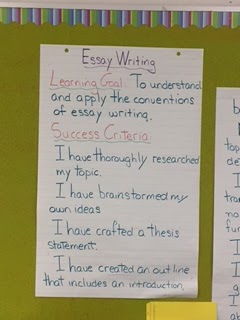
Two strategies that we use to support our students are learning goals and success criteria. Learning goals are statements that make it clear what students are learning. Success criteria is a list of descriptions of how students can be successful with a particular task or skill. Success criteria is more effective when students have a role in developing what good work looks like. The logic behind this is if students have a clear understanding of what they are learning and a clear target of what good work looks like, they will be more successful. Here are some examples of learning goals and success criteria in Boxwood classrooms.


Tuesday, 6 December 2016

Hour of Code at Boxwood

During Computer Science Education Week (December 5th - 9th, 2016), students from all over the world will be participating in The Hour of Code. The Hour of Code is a one-hour introduction to computer science. Students and teachers can choose from a variety of activities for kindergarten and up. "Coding" refers to computer programming. This is important because computers are and will continue to be a big part of our future. We want to support our students to gain the ability to create technology. Various classes are taking part in "coding" activities this week. Here are a few pictures of students coding. Special thanks goes out to Ms. Calverley for organizing this learning opportunity to support our future computer programmers!